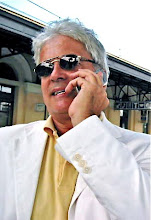
Not a cloud in the sky! Bellissimo!
For dinner yesterday, we had wholewheat pasta with radicchio, followed by salad featuring tomatoes grown in volcanic soil, fresh basilico, and bianchi di spagna beans. Blood oranges from Sicily for dessert and pure chocolate chunks with tiny bits of rock salt embedded in them.
Wednesday, April 1, 2009

Roma!
Bella Roma has given me a warm but very wet welcome on my return after about a year and a half. It feels wonderful to be here; I've already indulged in several cappuccinos and even a couple of tramezzini with artichoke hearts and mozzarella - heaven!
The weather report is promising, so I'll have photos soon.
Ciao a tutti!
Bacioni & abbracci!
The weather report is promising, so I'll have photos soon.
Ciao a tutti!
Bacioni & abbracci!
Saturday, March 28, 2009
My Novel

…an island, an entity…
Pan’s Dominion
Following his brother Derek’s gruesome murder on the Isle of Capri, Webb Knecht arrives there to find himself at the epicenter of ancient occult forces that soon threaten his sanity and even his very existence. In the course of the unspeakable unfolding, disturbing encounters with esoteric eccentrics both living and dead, he finds true love – or is it? – ultimately coming face to face with his own appalling yet transcendent destiny, his uniquely fated martyrdom.
The hero of this pagan-Christian tale is a sort of modern Christ figure whose challenge is to transform not only himself, but the world of hypocrisy and fear that engulfs him.
“Flamboyant travesties of mystical history reveal the shocking essence of the world’s most mythic isle.”

Flesh and Word, the Father and the Son
D. H. Lawrence, from his Foreword to Sons and Lovers:
John, the beloved disciple, says, 'The Word was made Flesh.' But why should he turn things round? The women simply go on bearing talkative sons, as an answer. 'The Flesh was made Word.'
For what was Christ? He was Word, or he became Word. What remains of him? Word! No flesh remains on earth, from Christ; perhaps some carpentry he shaped with his hands retains somewhere his flesh-print; and then his word, like his carpentry, just the object that his flesh produced, is the rest. He is Word. And the Father was Flesh. For even if it were by the Holy Ghose his spirit was begotten, yet flesh cometh only out of flesh. So the Holy Ghost must either have been, or have borne from the Father, at least one grain of flesh. The Father was Flesh--and the Son, who in himself was finite and had form, became Word. For form is the Uttered Word, and the Son is the Flesh as it utters the Word, but the unutterable Flesh is the Father.
And the Word is not spoken by the Father, who is Flesh, forever unquestioned and unanswerable, but by the Son. Adam was the first Christ: not the Word made Flesh, but the Flesh made Word. Out of the Flesh cometh the Word, and the Word is finite, as a piece of carpentry, and hath an end. But the Flesh is infinite and has no end. Out of the Flesh cometh the Word, which blossoms for a moment and is no more. Out of the Flesh hath come every Word, and in the Flesh lies every Word that will be uttered. The Father is the Flesh, the eternal and unquestionable, the law-giver but not the law; whereas the Son is the mouth. And each law is a fabric that must crumble away, and the Word is a graven image that is worn down, and forsaken like the Sphinx in the desert.
John, the beloved disciple, says, 'The Word was made Flesh.' But why should he turn things round? The women simply go on bearing talkative sons, as an answer. 'The Flesh was made Word.'
For what was Christ? He was Word, or he became Word. What remains of him? Word! No flesh remains on earth, from Christ; perhaps some carpentry he shaped with his hands retains somewhere his flesh-print; and then his word, like his carpentry, just the object that his flesh produced, is the rest. He is Word. And the Father was Flesh. For even if it were by the Holy Ghose his spirit was begotten, yet flesh cometh only out of flesh. So the Holy Ghost must either have been, or have borne from the Father, at least one grain of flesh. The Father was Flesh--and the Son, who in himself was finite and had form, became Word. For form is the Uttered Word, and the Son is the Flesh as it utters the Word, but the unutterable Flesh is the Father.
And the Word is not spoken by the Father, who is Flesh, forever unquestioned and unanswerable, but by the Son. Adam was the first Christ: not the Word made Flesh, but the Flesh made Word. Out of the Flesh cometh the Word, and the Word is finite, as a piece of carpentry, and hath an end. But the Flesh is infinite and has no end. Out of the Flesh cometh the Word, which blossoms for a moment and is no more. Out of the Flesh hath come every Word, and in the Flesh lies every Word that will be uttered. The Father is the Flesh, the eternal and unquestionable, the law-giver but not the law; whereas the Son is the mouth. And each law is a fabric that must crumble away, and the Word is a graven image that is worn down, and forsaken like the Sphinx in the desert.
Tuesday, February 24, 2009


Wednesday, February 11, 2009
The Symbolist Works of Ferdinand Hodler
Ferdinand Hodler (1853-1918) was a celebrated Swiss painter whose style evolved into a very distinct form of Symbolism.
In the last phase of his life, his works almost verged on Expressionism, with strong colors and barely suggested, abstracted settings. In particular, he developed a style called Parallelism, in which groups of figures are symmetrically arranged almost geometrically across the canvas, in poses suggesting dance or ritual.
His final works also showed strong emotional reactions not only to the slow, painful death due to cancer in 1915 of his mistress, Valentine Godé-Darel, but also to the simultaneous ghastly horrors of WWI.
He left a significant number of unfinished works.
Hodler's most renowned works include "Night":

And "Day":

Other important canvases in a similar vein include "Truth":

And other works:


His particular penchant for showing women with long dresses adhering to their legs appears again and again, as well as for depicting women with elongated necks in hieratic poses:


Whereas his masterful, subtle modeling of the body, is revealed in a number of other works and sketches:


Most powerful is a large, unfinished anti-war piece, in which the figures are about one-half life-size. It is an almost Expressionistic canvases, depicting the Greek Goddess of Discord, Eris, holding the black Apple of Discord, a kind of Angel of Death figure flanked by two nude warriors, of different races, with an apparently dead baby at their feet. In this work, the artist betrays the fullest, darkest rage and despair at the ravages of human madness:

Although the actions of the bodies display similar iconography, here in the above work, a reaction to the brutal actualities of war, we see a stark contrast to earlier works, public murals, in which he glorified historic warfare as patriotic defense:


In the last phase of his life, his works almost verged on Expressionism, with strong colors and barely suggested, abstracted settings. In particular, he developed a style called Parallelism, in which groups of figures are symmetrically arranged almost geometrically across the canvas, in poses suggesting dance or ritual.
His final works also showed strong emotional reactions not only to the slow, painful death due to cancer in 1915 of his mistress, Valentine Godé-Darel, but also to the simultaneous ghastly horrors of WWI.
He left a significant number of unfinished works.
Hodler's most renowned works include "Night":

And "Day":

Other important canvases in a similar vein include "Truth":

And other works:


His particular penchant for showing women with long dresses adhering to their legs appears again and again, as well as for depicting women with elongated necks in hieratic poses:


Whereas his masterful, subtle modeling of the body, is revealed in a number of other works and sketches:


Most powerful is a large, unfinished anti-war piece, in which the figures are about one-half life-size. It is an almost Expressionistic canvases, depicting the Greek Goddess of Discord, Eris, holding the black Apple of Discord, a kind of Angel of Death figure flanked by two nude warriors, of different races, with an apparently dead baby at their feet. In this work, the artist betrays the fullest, darkest rage and despair at the ravages of human madness:

Although the actions of the bodies display similar iconography, here in the above work, a reaction to the brutal actualities of war, we see a stark contrast to earlier works, public murals, in which he glorified historic warfare as patriotic defense:


Monday, February 2, 2009
A Poem
Seems a suitable moment for a little poem I wrote when I was sixteen, a sophomore in high school:
Procession
What day is this you laud and praise?
Why is this day a day of days?
I will admit it's clear and bright,
but what's this day
and by what right?
The Dragon is here,
as well as the Bell.
Look! One chained and shackled!
I think he just fell.
Your leaden procession
trails down the warped street
and into the ocean.
Swan dive!
Quite a feat.
What day is this you laud and praise?
Why is this day a day of days?
I will admit it's clear and bright,
but what's this day
and by what right?
The Dragon is here,
as well as the Bell.
Look! One chained and shackled!
I think he just fell.
Your leaden procession
trails down the warped street
and into the ocean.
Swan dive!
Quite a feat.
Subscribe to:
Comments (Atom)